
 Ubigi eSIM
Ubigi has a quieter reputation than some louder competitors, but a consistent 4.1/5 Trustpilot rating from over 35,000 reviews and backing from Transatel — part of the NTT Group, one of the world's largest telecom companies — suggest it's worth a closer look. It's also one of the only providers on this site offering genuine monthly and annual recurring plans. Here's what the real data shows about pricing, coverage, and support.
Ubigi's real strength is quiet consistency: a 4.1/5 rating held steady across tens of thousands of reviews, genuinely competitive pricing on larger data plans, and the backing of Transatel — part of the NTT Group — which likely explains the repeated praise for its performance in Japan specifically, where NTT's own Docomo network is one of Ubigi's named local partners. It's also one of the few providers here offering real monthly and annual recurring plans for frequent travelers, plus an experimental IP-changer feature no other provider on this site has. The trade-offs: support isn't true live chat, small data packages under 5GB are limited, and one-off plans max out at 30 days.
Ubigi was founded in 2017 and is based in Paris, France, operated by Transatel, a company that's part of the NTT Group — one of the largest telecom companies in the world, and the parent of NTT Docomo, a major Japanese carrier. That corporate backing is unusual in this category, where most providers are smaller, newer, purely eSIM-focused startups reselling access through third-party carrier deals. It likely explains a recurring pattern in real reviews: Ubigi gets specifically strong, repeated praise for performance in Japan, where it can offer genuine multi-network redundancy — reviewers experiencing weak signal in specific spots have been told by Ubigi's own support team to manually switch between its partner networks, KDDI and Docomo, to find a stronger connection.
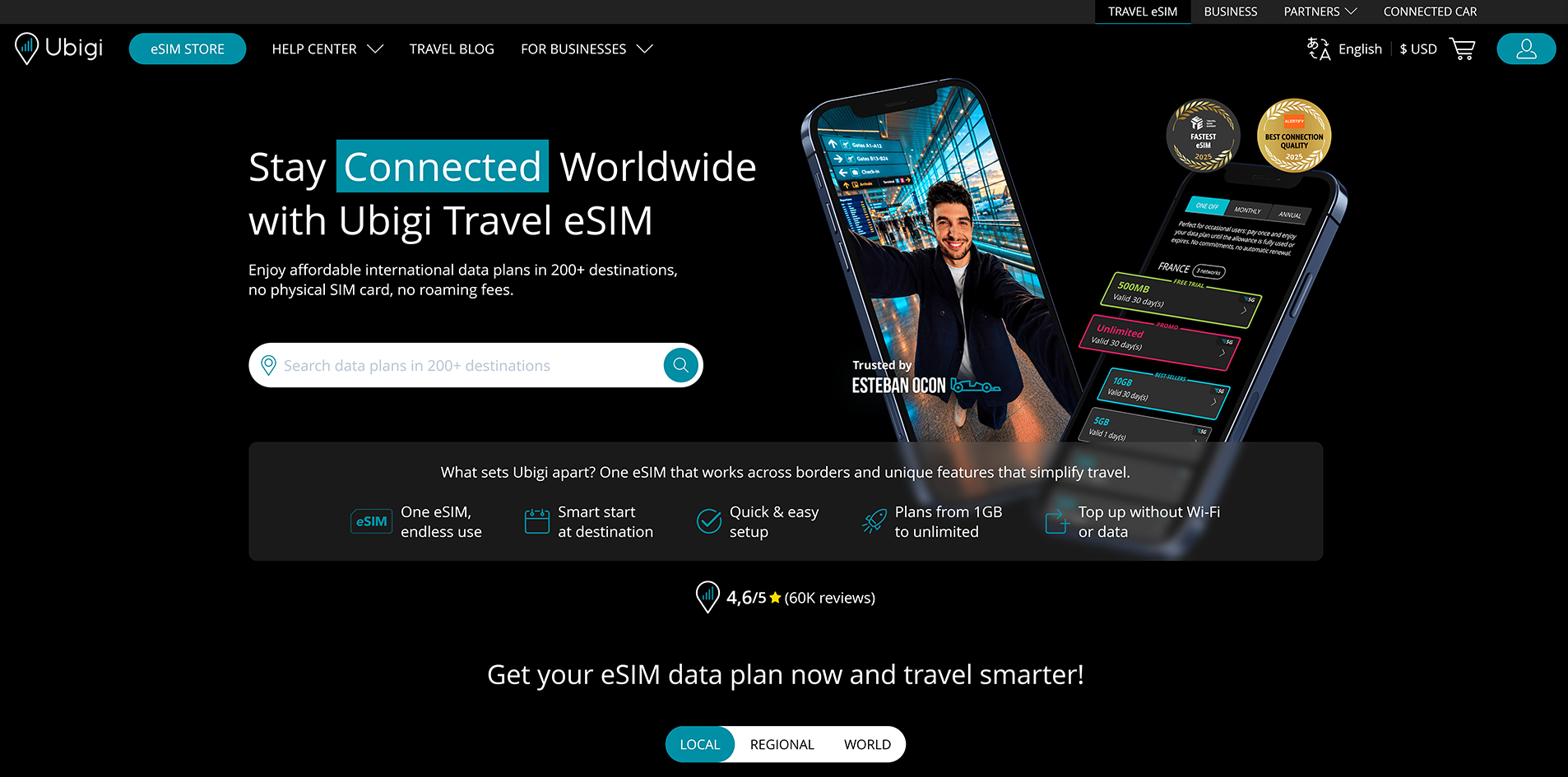
Ubigi covers 200+ destinations, with one independent tester recording an average speed of 148.8 Mbps across multiple locations — a genuinely strong result for the category. Real reviews consistently praise performance in Japan and across Europe, with specific mentions of strong, reliable coverage in the UK and Italy. That said, coverage isn't uniform everywhere: several reviewers report specific dead zones even within well-covered countries — one specific complaint centered on a particular train station in Osaka, another on parts of Ohio in the US — and a few describe occasional drops that required manually restarting the connection or the phone. As with every reseller-based eSIM, your experience depends on which local partner network you connect to in a given spot, not just the country as a whole.
Ubigi is managed through its app or website, and setup is completely free — there's no activation or setup charge, you only pay for the data plan itself. Real reviews describe the core purchase-to-connection flow as simple, often activating automatically the moment a phone leaves airplane mode after landing. That said, the app is on the more bare-bones side compared to some competitors, and a handful of specific setup complaints turn up repeatedly: APN settings not auto-configuring in some cases (requiring manual entry), and confusion over whether to recharge an existing plan or purchase a new one when topping up. Neither is a dealbreaker, but both are worth knowing about before you rely on a completely hands-off setup.
We don't have Ubigi in our own first-party pricing database the way we do for some other providers on this site, so the figures below come from Ubigi's own published rates and independent test reports, cited as such. Ubigi's 30-day plans typically start around $6 for 1GB, with per-GB value improving noticeably at larger sizes — a 10GB/30-day plan has been reported as low as $15 in some destinations. That pricing structure is a real, consistent pattern across independent reviews: small data packages under 5GB are comparatively limited in choice, while larger, longer-duration plans tend to offer the strongest value on this site.
Ubigi also stands out for offering genuine monthly and annual recurring plans, some with unlimited data — a structure few competitors on this site provide at all. These plans auto-renew, and the cancellation terms matter: monthly plans can be cancelled after three months, but annual plans cannot be cancelled once purchased, so treat an annual commitment as final before you buy.
Note: single-purchase, one-off Ubigi plans max out at 30 days — if you need continuous coverage longer than that without manually rebuying, a recurring monthly or annual plan is the only way to get it with Ubigi.
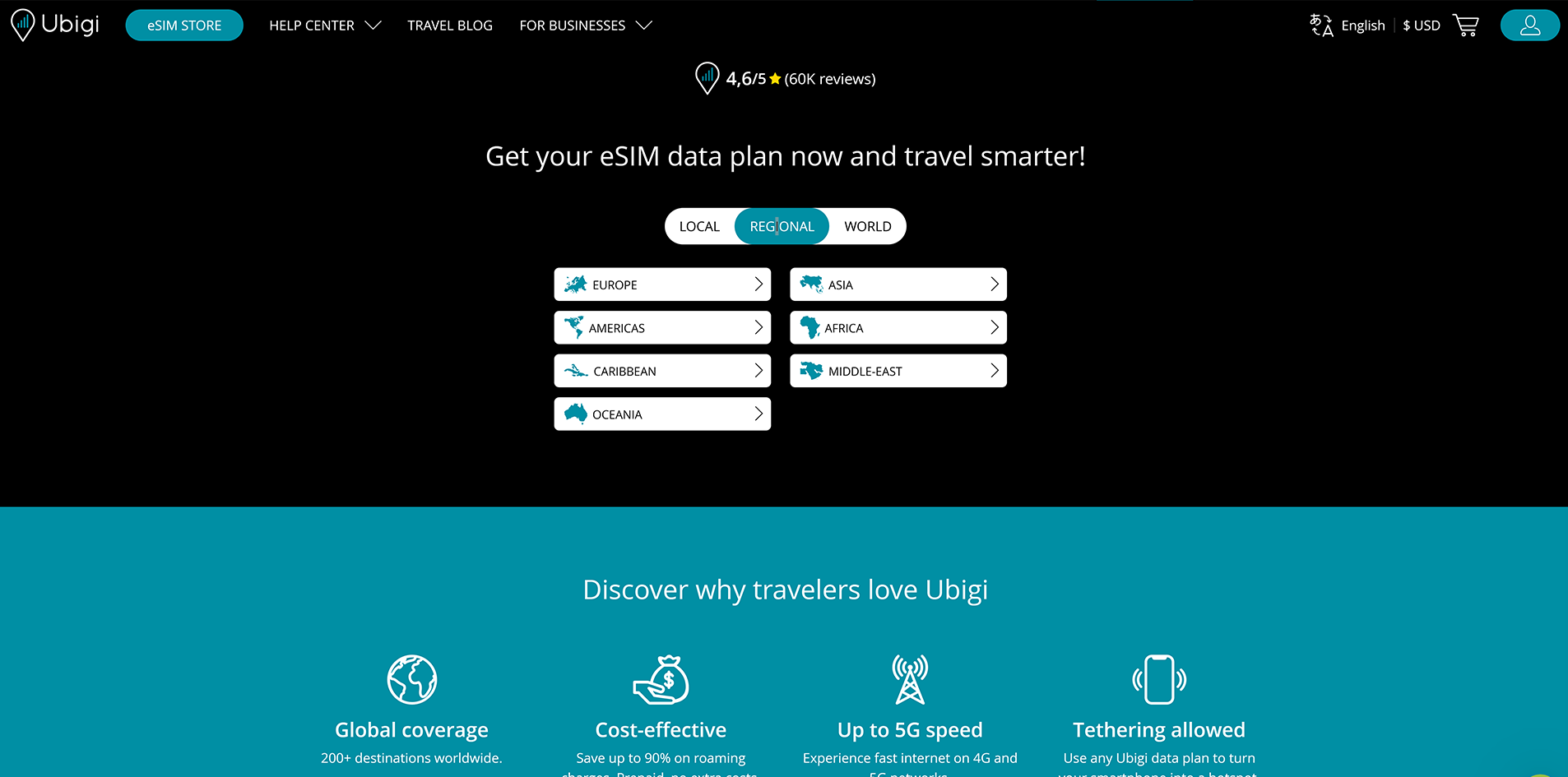
Ubigi holds a consistent 4.1 out of 5 rating on Trustpilot from more than 35,000 reviews — a figure that's held remarkably steady across independent sources and snapshots, which speaks to real consistency rather than a rating propped up by a small or recent review base. Positive reviews repeatedly praise easy setup, automatic activation on arrival, and strong performance specifically in Japan and across Europe — one long-time user reported using Ubigi reliably across Japan, London, and the Netherlands over two years. The clearest negative pattern involves inconsistent signal in specific pockets even within generally well-covered countries, occasional connection drops requiring a manual restart, and — in a smaller number of cases — real frustration when a plan ran out unexpectedly with no clear way to reach support quickly for a top-up.
Genuine subscription options, some unlimited, for frequent travelers — a structure few competitors on this site offer at all.
Operated by Transatel, part of NTT Group, with real network partnerships including NTT Docomo in Japan.
You only ever pay for the data plan itself — no separate charge to activate or set up the eSIM.
An experimental feature letting eligible users switch between a travel-location IP and a home-country IP — currently in beta for France and US residents.
| Plan type | Coverage | Best for |
|---|---|---|
| One-off (single purchase) | A single country or region, up to 30 days | Standard trips, most travelers |
| Monthly recurring | Ongoing, auto-renews, cancellable after 3 months | Regular travelers who don't want to rebuy each trip |
| Annual recurring | Ongoing for 12 months, cannot be cancelled | Committed, year-round frequent travelers only |
As a rough guide: if your trip is a single vacation or business trip, a one-off plan is the simplest choice — just size it to your data needs, since small packages under 5GB have fewer options and larger plans tend to offer better value per gigabyte. If you travel internationally several times a year, the monthly recurring plan is worth comparing against just buying fresh one-off plans each trip — but think carefully before committing to the annual plan specifically, since it locks you in with no cancellation option.
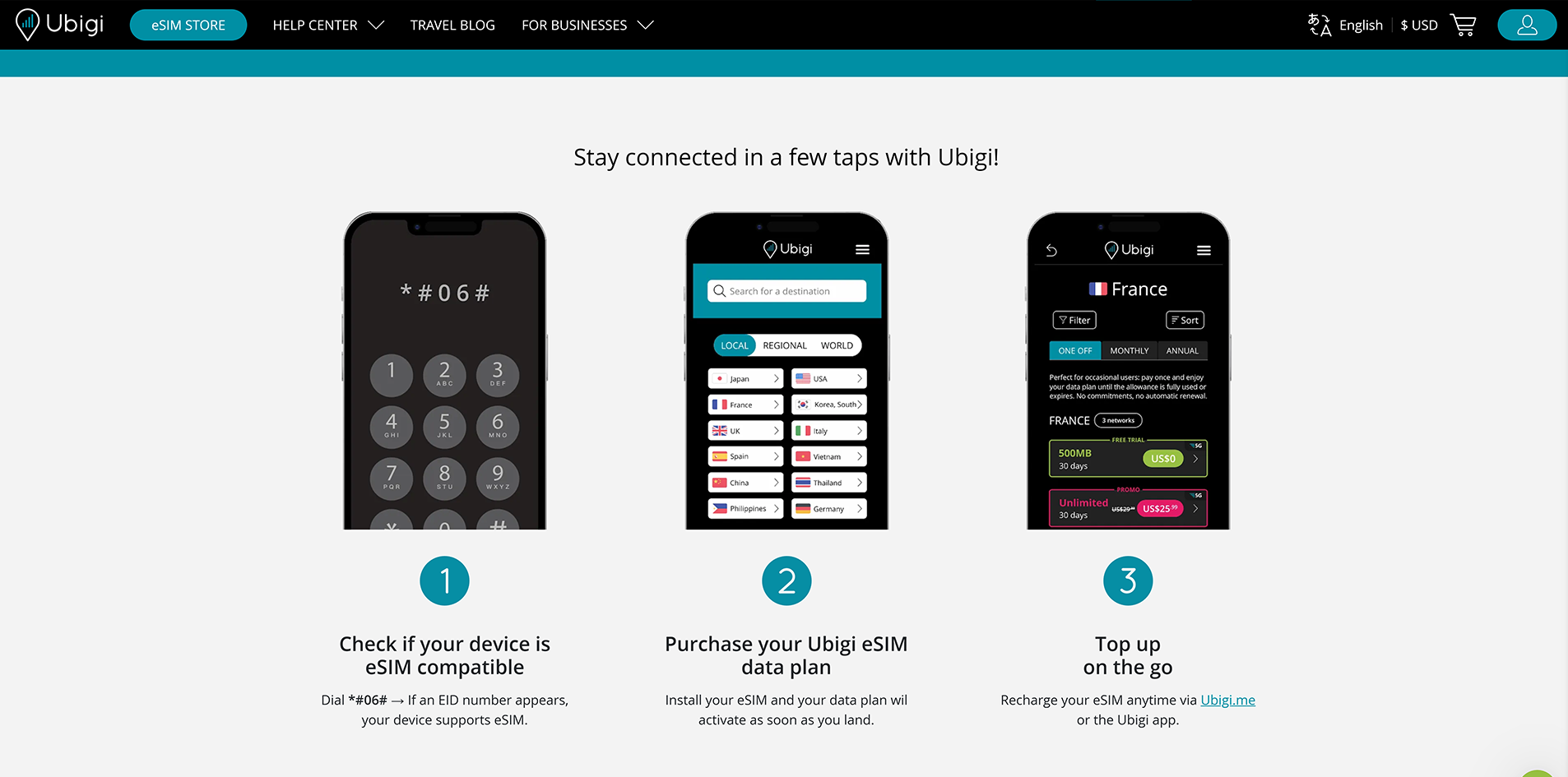
Purchase a Ubigi plan via the app or website while you still have Wi-Fi — ideally before you leave home.
Follow the QR code or in-app installation flow. If APN settings don't configure automatically, check Ubigi's setup guide for manual entry steps.
Many users report the plan activating automatically the moment they take their phone off airplane mode after arrival.
On Android, also enable Data Roaming for the Ubigi line under Mobile Networks — this step isn't required on iPhone.
In destinations with multiple Ubigi partner networks (like KDDI and Docomo in Japan), you can manually switch in your phone's settings if one network is underperforming in a specific spot.
Ubigi's support is available through a help center and a website chat widget, but the chat isn't true live chat — it creates a support ticket rather than connecting you to a human in real time. One detailed independent test found a reply arrived in about 7 minutes despite the ticket-based system, which is reasonably fast in practice even without instant chat. Ubigi's team is also active on Trustpilot, replying to reviews with specific, personalized troubleshooting steps rather than generic responses — including destination-specific advice like which alternate local network to switch to if one partner is underperforming.
Ubigi doesn't have the loudest marketing in this category, but the data backs up a genuinely solid, consistent service: a 4.1/5 rating held steady across tens of thousands of reviews, real corporate backing from Transatel and the NTT Group, and standout performance in Japan and Europe specifically. Its recurring monthly and annual plans are a real, distinctive option for frequent travelers that most competitors on this site simply don't offer. The trade-offs are support that isn't quite real-time, thinner options for small data packages, and a 30-day cap on one-off plans. For travelers who want a reliable, well-backed eSIM and don't need instant live chat, Ubigi is a strong, understated choice. If you specifically want a broader small-plan selection or faster live support, it's worth comparing against Saily or Airalo first.

A larger Trustpilot track record and more options for small data packages under 5GB.

The widest single-country selection of any major eSIM, with more flexible short-trip plan sizes.
See our full eSIM provider comparison for more options.
This review is compiled from Ubigi's own published plan and coverage data, verified Trustpilot and app store reviews, and cross-checked independent test reports, current as of the update date above. Pricing here is not drawn from our own first-party pricing database — Ubigi wasn't part of that dataset — and is instead cited directly from Ubigi's published rates and independent testing. We do not accept payment for positive coverage, and we review this page on an ongoing basis to keep it current.
Editorial note: this page contains affiliate links, including to Ubigi. We may earn a commission if you purchase through them, at no extra cost to you. This does not influence our testing process or verdict. Ratings shown are accurate as of the update date above and sourced from Trustpilot, official provider data, and independent third-party testing as cited.